
AI development services that go beyond the demo
We design, train and deploy machine learning and large language model systems that work on your data, with evaluation and monitoring so they keep working in production. Our data scientists bring research backgrounds in medical imaging and applied machine learning.
Practical AI for Pakistan. We build AI that works with the documents and data Pakistani businesses already have, in English and Urdu: assistants over policies, contracts and manuals, document extraction from invoices and forms, demand forecasting for distributors, defect detection on production lines, and medical imaging support for clinics. Models can run on your own servers when data must stay in the country.
What we build
- LLM assistants and search: retrieval-augmented systems over your documents, case law, manuals or tickets, with citations and access control
- Model customization: prompt engineering, fine-tuning of open models such as LLaMA, and evaluation sets that tell you whether a change helped
- Predictive models: demand, churn, risk, maintenance and quality forecasts integrated into your workflows
- Computer vision: defect detection, counting, document and image classification, and medical image processing
- Document automation: extraction from invoices, contracts, forms and reports into structured data
- Chat and voice interfaces for customers and staff, grounded in your systems and policies
How we approach AI projects
Most AI projects fail on data, evaluation or cost rather than on the model. Our process addresses those first.
Problem and baseline
Define the decision or task, the current manual baseline and what better looks like in numbers.
Data readiness
Audit what you have, fix labels and gaps, set up a secure pipeline. This step decides the project.
Prototype and evaluate
A small working system tested against a held-out evaluation set and reviewed by your domain experts.
Integrate
APIs, user interfaces and permissions, so the model sits inside the workflow instead of a separate tool.
Deploy with guardrails
Monitoring for drift and cost, human review where stakes are high, and rollback paths.
Improve
Feedback loops that turn corrections into training data and measured improvements.

Example: legal research with sources
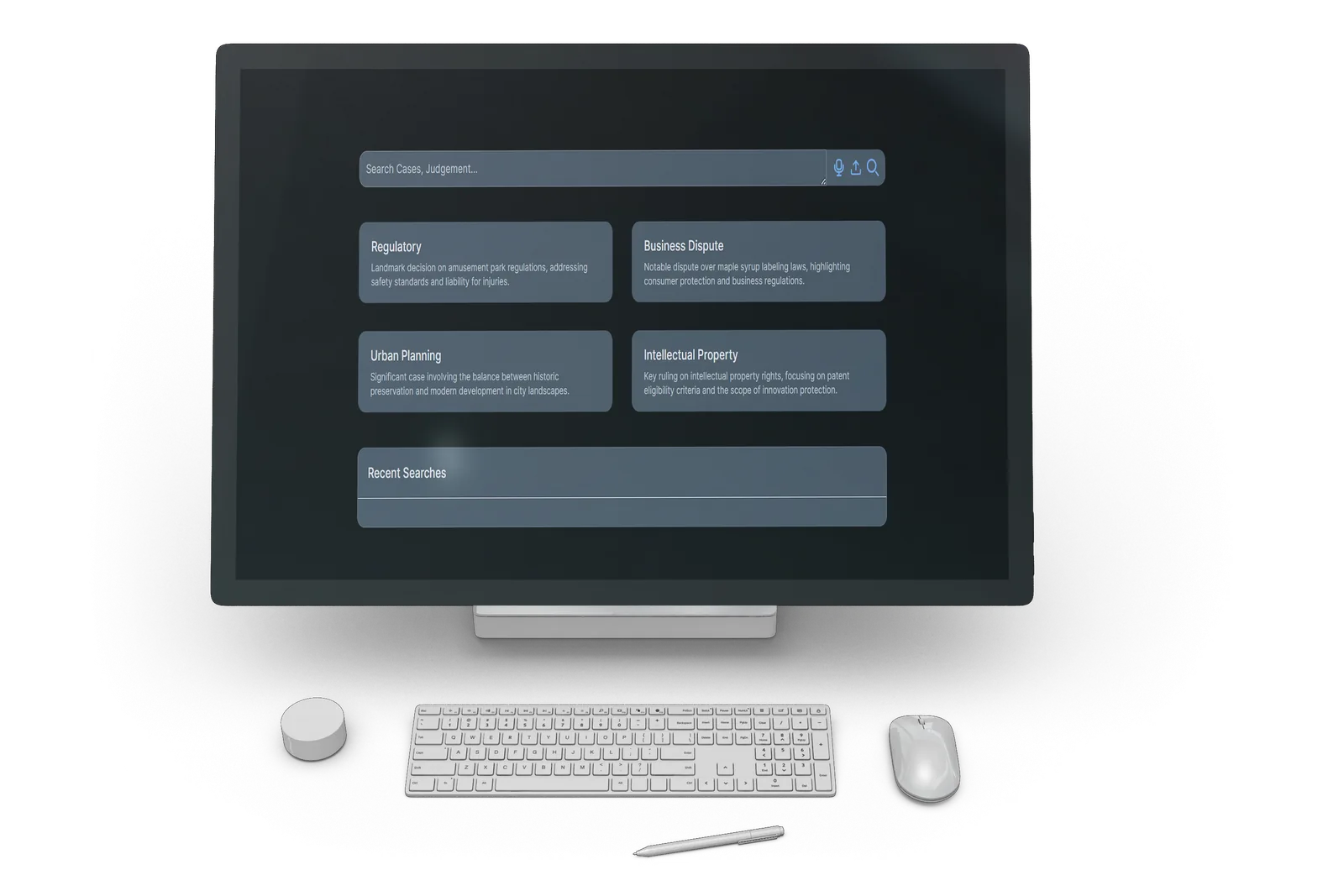
Case Polaris answers legal questions over a library of Canadian case law. Every query returns two outputs: a summarized chat answer and a ranked list of the cases it drew on, so lawyers can verify rather than trust. Subscriptions, usage limits and secure payments through Stripe are part of the same system.
Industries
Legal, healthcare and clinical data, education and assessment, manufacturing quality, energy and retail analytics.
Frequently asked questions
Do we need a lot of data to use AI?
For LLM-based assistants, no: they work on the documents you already have. For custom predictive or vision models, a few thousand well-labelled examples are often enough to start, and we design the system to improve as more data arrives.
How do you prevent an AI assistant from making things up?
Retrieval with citations, restricted answer scopes, evaluation sets built with your experts, and a human-review path for high-stakes outputs. We measure accuracy before and after every change.
Can our data stay private?
Yes. We can deploy open-weight models on your own servers, use providers with no-training data agreements, or combine both. Access is role-based and logged.
What does an AI project cost to run?
We estimate inference and hosting costs during the prototype, set budgets and monitor them in production. Many systems cost far less to run than the manual process they replace.
Tell us about your project
A 30-minute call is enough to scope most projects. We reply within one business day.